Most penis extender guides compare devices by price, brand reputation, or tension rating.
What they almost never cover is how body type changes which device actually fits. A man who carries extra weight in the pubic area has a fundamentally different fitting challenge than a lean man with a very short flaccid length. A man with Peyronie’s disease needs directional traction, not just a straight-axis pull.
Getting this match right determines whether traction therapy produces results or wastes months. This guide covers the body type variables that most affect extender performance and gives specific guidance for each profile. Let’s discuss.
Why Does Body Type Change? Which Best Penis Extender Actually Works?
Body type changes, which extender works, because every component of the device interacts directly with your specific anatomy.
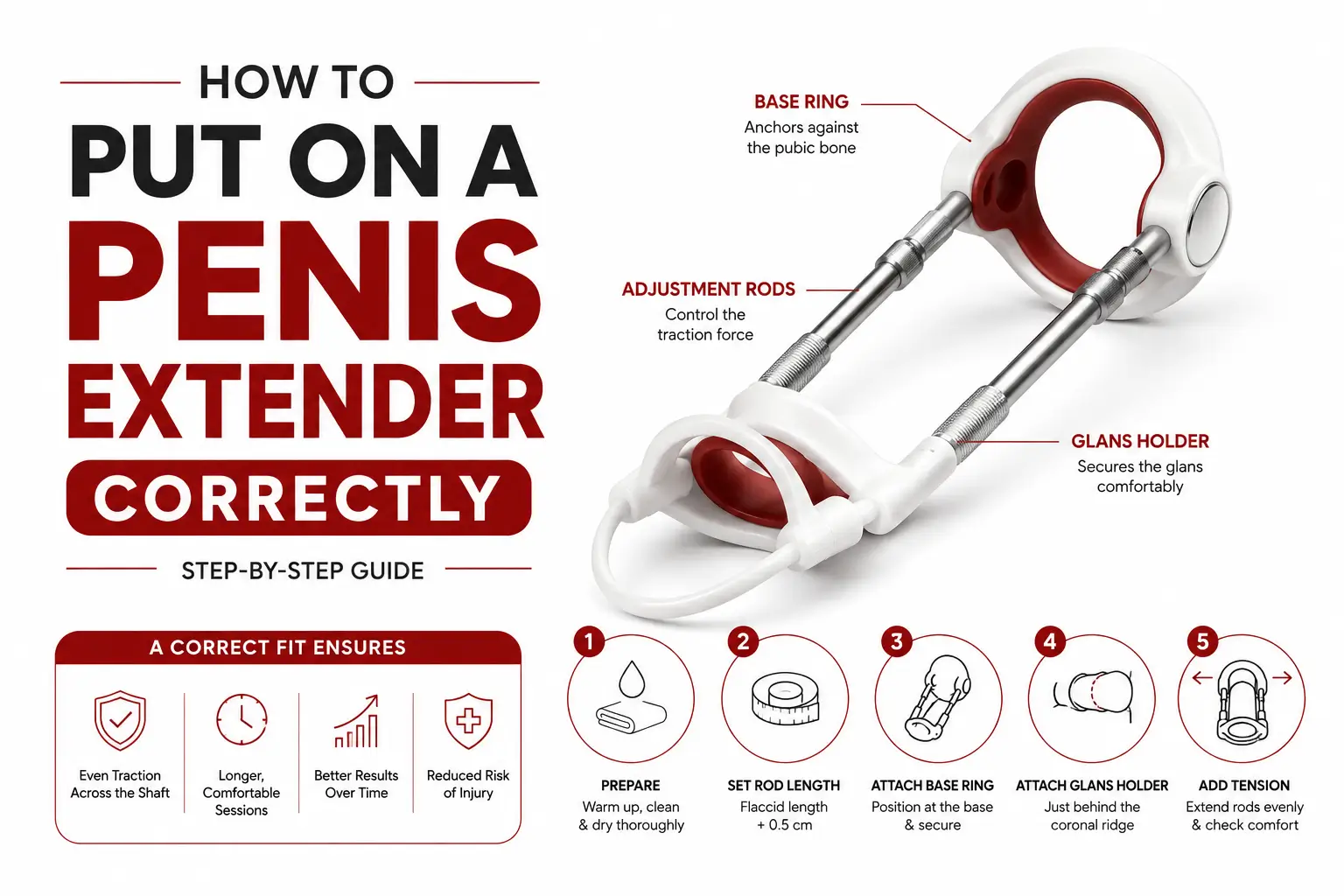
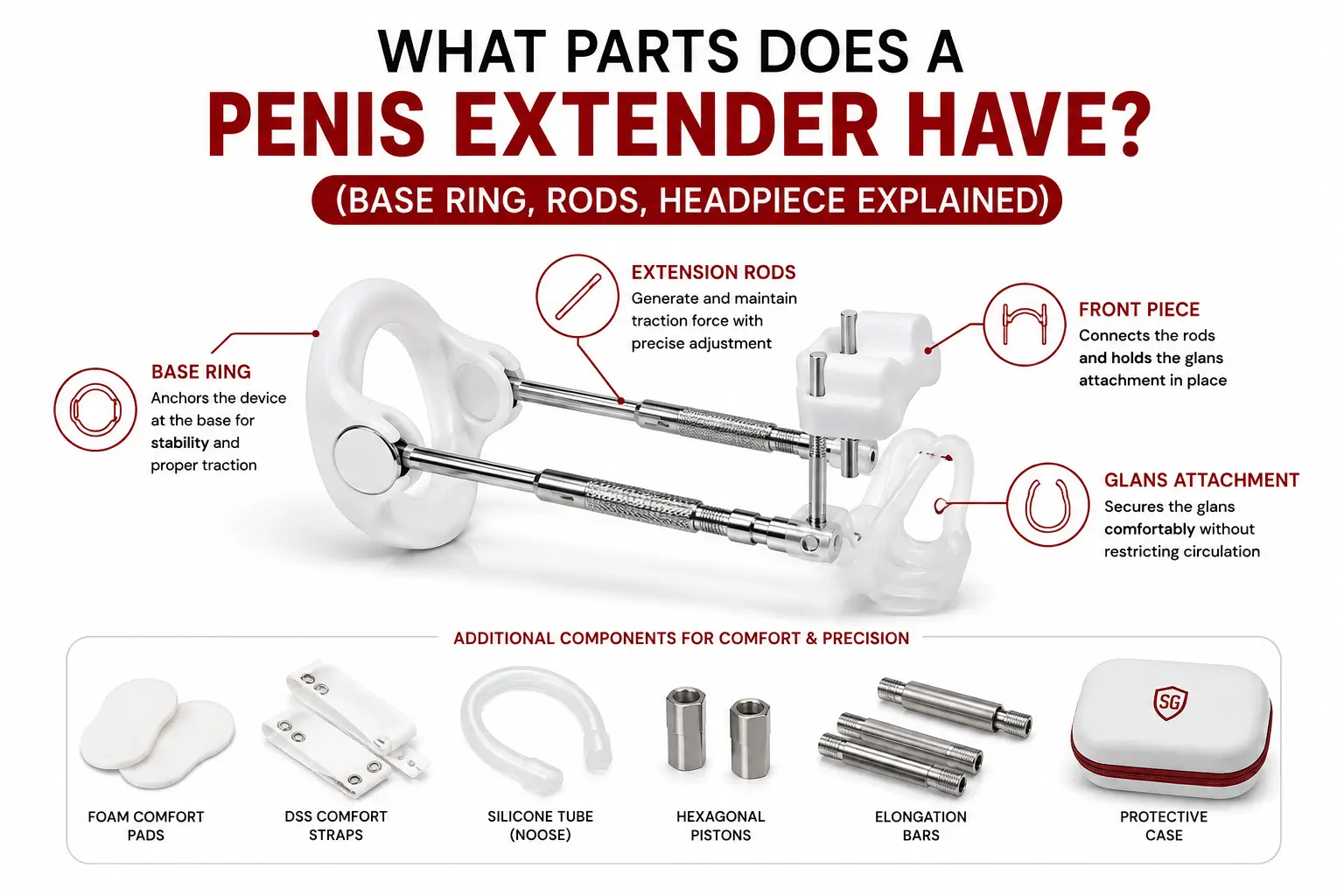
A traction extender has four mechanical components:
- Base ring: anchors at the pubic bone
- Adjustable extension rods: run along either side of the shaft and create traction
- Glans attachment: transmits the pulling force from the rods to the penis
- Tension mechanism: calibrates force in precise increments
Body fat distribution, flaccid length, shaft girth, circumcision status, and the presence of curvature all determine how well each component performs its job.
Two examples that make this concrete:
The base ring needs to sit flush against the pubic bone to anchor correctly. In men with significant suprapubic fat, the ring sinks into soft tissue rather than anchoring against bone — reducing mechanical efficiency and increasing skin irritation risk. No amount of tension calibration fixes a base ring floating in fat instead of anchored at the pubic symphysis.
A man with a very short flaccid length needs a device whose minimum rod configuration matches his anatomy. Many standard extenders have a minimum assembled length that exceeds what a short or retracted flaccid presents, making correct fitting physically impossible.
These are not edge cases. They are practical barriers that drive early abandonment of otherwise valid therapy.
Does Flaccid Length Change Which Device You Should Use?
Yes. Flaccid length is the single most important measurement for choosing an extender because the device fits over the flaccid shaft, not the erect one.
| Flaccid length | Primary challenge | Device priority |
| Under 3 inches (7.5 cm) | Standard rod minimum lengths create immediate over-tension | Modular short-configuration rods; vacuum-based attachment systems |
| 3 to 5 inches (7.5 to 12.5 cm) | Standard fit — most quality devices work | Focus shifts to comfort system, attachment type, and regulatory pedigree |
| Over 5 inches (12.5 cm) | Rods need extension segments or a long-reach frame | Verify the device extends at least 3 cm beyond current flaccid length |
Two options for men with a very short flaccid length:
Option 1 — Modular rod architecture: Look for extenders with high short-end adjustability. SizeGenetics addresses this through its 58-way comfort system and modular rod design, which allows fine granular length adjustment at the lower end of the range. This adjustability is not just about comfort — it delivers biomechanical precision when standard lengths do not fit.
Option 2 — Vacuum-based attachment: Vacuum cup systems grip the glans regardless of shaft length, with no minimum rod configuration constraint. The fitting works from the glans outward rather than from a fixed frame length inward.
For average flaccid length, the decision shifts to comfort system, attachment type, and clinical evidence base. SizeGenetics and Jes-Extender both operate comfortably within this range and carry the clinical documentation to match.
How Does Shaft Girth Affect the Base Ring and Overall Fit?
Shaft girth directly determines whether the base ring anchors correctly and whether the glans attachment stays secure.
Base ring fit by girth:
| Girth profile | Risk | Solution |
| Above average | Standard ring too narrow to slide over shaft; or too tight once seated | Two-piece or hinged base ring design that opens for comfortable positioning |
| Below average | Ring floats or rotates during movement; creates asymmetric tension | Smaller ring that anchors without tilting during wear |
Before purchasing any device, check whether the manufacturer publishes base ring dimensions or offers sizing guidance. This detail rarely appears prominently on product pages but matters significantly for men at either extreme of the girth range.
Glans attachment by girth:
Vacuum cup systems conform to the shape of the glans regardless of exact dimensions, making them forgiving for wider or narrower coronal ridges. Noose and strap systems depend on the coronal ridge providing a sufficient physical stop — less reliable when the glans-to-shaft diameter differential is small.
How Does Body Weight and Pubic Fat Affect Extender Performance?
For heavier men, the suprapubic fat pad is the central fitting challenge — and it creates three specific problems.
| Problem | What happens |
| Ring shifts position during movement | Creates asymmetric tension across the shaft |
| Padding effect inflates perceived device length | Produces false starting tension that feels insufficient at the tissue level |
| Fat presses against ring during seated use | Causes skin irritation and chafing at the ring contact point after extended sessions |
Two practical fixes:
Fix 1 — Measure correctly. When setting rod length, push the ruler firmly against the pubic bone (compressing any fat) rather than measuring from the skin surface. This produces the bone-pressed penile length (BPEL) — the anatomically accurate measurement for setting device length. Surface measurement produces a false reading that missets tension from session one.
Fix 2 — Choose a high-comfort, multi-configuration device. A wider or more padded base ring distributes pressure over a larger surface area rather than concentrating it at a narrow edge against soft tissue. SizeGenetics’ 58-way comfort architecture — which allows users to rotate between foam padding, silicone inserts, and different ring geometries — handles this population better than basic single-configuration frames.
For heavier users, the goal is a base ring that stays anchored and comfortable through longer sessions without continually shifting position.
What Device Features Work Best for Men With Peyronie’s Disease or Curvature?
For Peyronie’s disease, directional traction outperforms straight-axis traction — especially for curvature above 20 degrees.
Traction therapy for Peyronie’s disease works best when the force targets the plaque specifically, pulling tissue in the direction that places the plaque under counter-directional load. A straight-axis device treats curvature incidentally rather than precisely.
A 2025 Cureus systematic review covering over 1,000 patients found that modern devices designed for directional traction achieved mean curvature reductions of 20 to 30% and penile length gains averaging 1.5 to 2.3 cm — outcomes that exceeded earlier studies using straight-axis devices.
What to look for in a device for Peyronie’s users:
- Dedicated curvature correction configurations or editions
- The ability to angle the traction vector relative to the shaft axis
- Medical certification from a manufacturer with documented Peyronie’s research
- A comfort system supporting several hours of daily use without forcing users off the device at the attachment points
| Curvature severity | Recommended approach |
| Under 20 degrees | Standard edition device with careful rod adjustment during fitting |
| 20 to 30 degrees | Curvature-specific device edition (SizeGenetics Curvature Home Treatment Edition; Jes-Extender Straightener) |
| Over 30 degrees | Consult a urologist before starting any traction protocol; curvature-specific device edition is the required starting point |
Does Circumcision Status Change How the Device Should Fit?
Circumcision status affects glans attachment specifically. It changes preparation and attachment choice, not device selection.
| Status | Fitting situation | Practical approach |
| Circumcised | Coronal ridge provides a reliable, unobstructed stop for strap and vacuum attachment | Standard fitting as per manufacturer instructions; no modification needed |
| Uncircumcised | Foreskin must be fully retracted before applying the device; without retraction, headpiece grips mobile foreskin tissue and slips off within minutes | Retract fully, then wrap the sulcus area with self-adherent gauze to protect foreskin tissue from friction at the attachment point |
Uncircumcised users need a slightly longer setup time and a gauze wrap as a standard supply item.
Vacuum cup attachment systems are particularly forgiving for uncircumcised users because suction grips the glans surface comprehensively without creating a single pressure edge that contacts foreskin tissue. If slippage is a recurring problem with strap systems, switching to a vacuum cup resolves it in most cases.
What Body Type Variables Affect How Many Hours Per Day You Can Realistically Wear the Device?
Sustainable daily wear time is where body type most directly impacts results — because 4 to 6 hours per day is the evidence-based minimum for meaningful tissue remodeling, and anything that cuts that short cuts results short.
| Lifestyle profile | Primary wear challenge | Practical solution |
| Sedentary or desk-based work | Device must be positioned correctly; horizontal position compresses against thigh | Point device downward along the thigh; wear loose-fitting trousers |
| Active or physically demanding work | Rods dig into the leg, shift position, or cause discomfort during bending | ADS (all-day stretcher) at lower tension during work hours; rod device for evening sessions |
| Higher body weight | Base ring contact point limits session length | Comfort padding; foam inserts; 45 to 60 minute repositioning breaks; build session duration more slowly than standard beginner protocols suggest |
The clinical study that documented 32% flaccid length increase required participants to wear the device for 4 to 5 hours per day for six months. That’s the benchmark. Any body type variable that reduces sustainable daily hours reduces the biological output proportionally.
How Do Age and Erectile Function Status Change the Device Decision?
| Profile | Key consideration | Device priority |
| Under 40 with good erectile function | Highest tissue plasticity; strongest traction response; tolerates progressive tension increases well | High maximum tension capability (SizeGenetics up to 2,800g) gives full range to progress through a complete multi-month protocol |
| Over 50 with declining erectile function | Traction upregulates eNOS, improving cavernosal blood flow and erectile quality independent of structural change; erection quality improvement may matter as much as length | High-comfort system for sustained daily use; moderate tension focus over maximum capability |
| Post-prostatectomy | Surgery frequently causes penile shortening through fibrosis and smooth muscle loss; traction now forms an established rehabilitation tool in urology | Clinically validated device with urologist guidance; Mayo Clinic RCT documented +1.6 cm length preservation vs. +0.3 cm in controls at 6 months |
| Active Peyronie’s disease (acute phase with pain) | Acute phase involves active inflammation and ongoing plaque formation; traction during this phase risks worsening curvature | Wait for the stable chronic phase; confirm disease phase with a urologist before starting any traction protocol |
Age and erectile function status change both what traction can deliver and how to structure use.
What Is the Right Match Between Body Type and Device?
Match your primary fitting challenge to the device characteristic that directly addresses it.
| Body type profile | Primary fitting challenge | Device characteristics to prioritize |
| Short flaccid (under 7.5 cm) | Minimum device length too long | Modular short-configuration rods; vacuum-based attachment |
| High body weight / pubic fat | Base ring anchors on soft tissue instead of pubic bone | Wide padded base ring; multi-configuration comfort system |
| Above-average girth | Base ring too narrow; strap slippage | Larger base ring options; vacuum cup attachment |
| Peyronie’s / curvature | Straight-axis traction misses plaque | Curvature-edition device with directional traction vector |
| Uncircumcised | Foreskin slippage at the headpiece | Gauze wrap routine; vacuum cup system preferred |
| Physically active work | Rigid rods impractical during movement | ADS for daytime; rod device for evening sessions |
| Post-prostatectomy rehab | Medical oversight required | Clinically validated device with urologist guidance |
| Over 50 / erectile function concern | Comfort for sustained use | High-comfort system; moderate tension focus |
Our Recommendation According to Your Requirement
Three devices serve different ends of this body type spectrum well, through genuinely different design philosophies, not just marketing differentiation.
SizeGenetics — best for users where sustained comfort across multiple daily hours is the primary challenge
This describes most body types on this list. The 58-way comfort system lets users rotate between noose straps, DSS straps, foam padding, and silicone configurations so no single contact point stays irritated across a 4 to 6-hour daily protocol. Key specs:
- FDA-registered Class II medical device
- Manufactured by Danamedic ApS in Denmark, with over 30 years of device development
- Tension range up to 2,800 grams — covers the full progression from beginner through advanced protocols
- Dedicated Curvature Home Treatment Edition for Peyronie’s disease — applies traction with a counter-directional component targeting plaque tissue directly
Jes-Extender — best for users who need a lighter, less bulky frame that fits into daily life without announcing itself
The aluminium-framed construction weighs notably less than steel-rod alternatives. That weight reduction matters across multi-hour daily sessions, particularly for men who find heavier devices uncomfortable against the thigh. Key specs:
- In clinical use since 1995; CE medical device certified
- Data accumulated across well over 500,000 users
- Lighter profile makes it better suited to seated or mobile contexts
- Straightener model available for curvature-specific protocols
ErectR — best for users who want a complete integrated system rather than a standalone traction frame
Where SizeGenetics and Jes-Extender are pure traction devices with decades of clinical history, ErectR positions itself for users at the beginning of their research who want a complete kit. For men who are new to traction therapy, uncertain about sustaining a multi-month protocol, and want supporting elements that make daily use more manageable, this approach lowers the barrier to getting started.