Most men unbox a penis extender, look at a pile of plastic and metal components, and have no idea what anything does.
The instruction booklet describes the sequence. It rarely explains why each part is shaped the way it is, what would happen if one component were absent, or how the combined system produces the tissue-level changes documented in clinical research.
Understanding what each part does (mechanically and biologically) changes how you use the device. It is the difference between blindly following steps and knowing exactly why each fitting decision matters. Let’s discuss.
What Problem Is a Traction Extender Designed to Solve, and Why Does It Need Multiple Parts?
A traction extender solves one mechanical objective: apply a sustained, calibrated pulling force along the axis of the penis for several hours per day, consistently enough and for long enough that the tunica albuginea responds by remodelling into a longer structure.
That single objective requires solving three simultaneous engineering problems:
- Anchor problem: The device needs a fixed point at one end that holds position against the body without slipping
- Force problem: It needs a force-generation mechanism in the middle that adjusts precisely and holds constant
- Grip problem: It needs a secure attachment at the distal end that grips the penis without cutting off blood flow, compressing nerves, or slipping loose during hours of movement
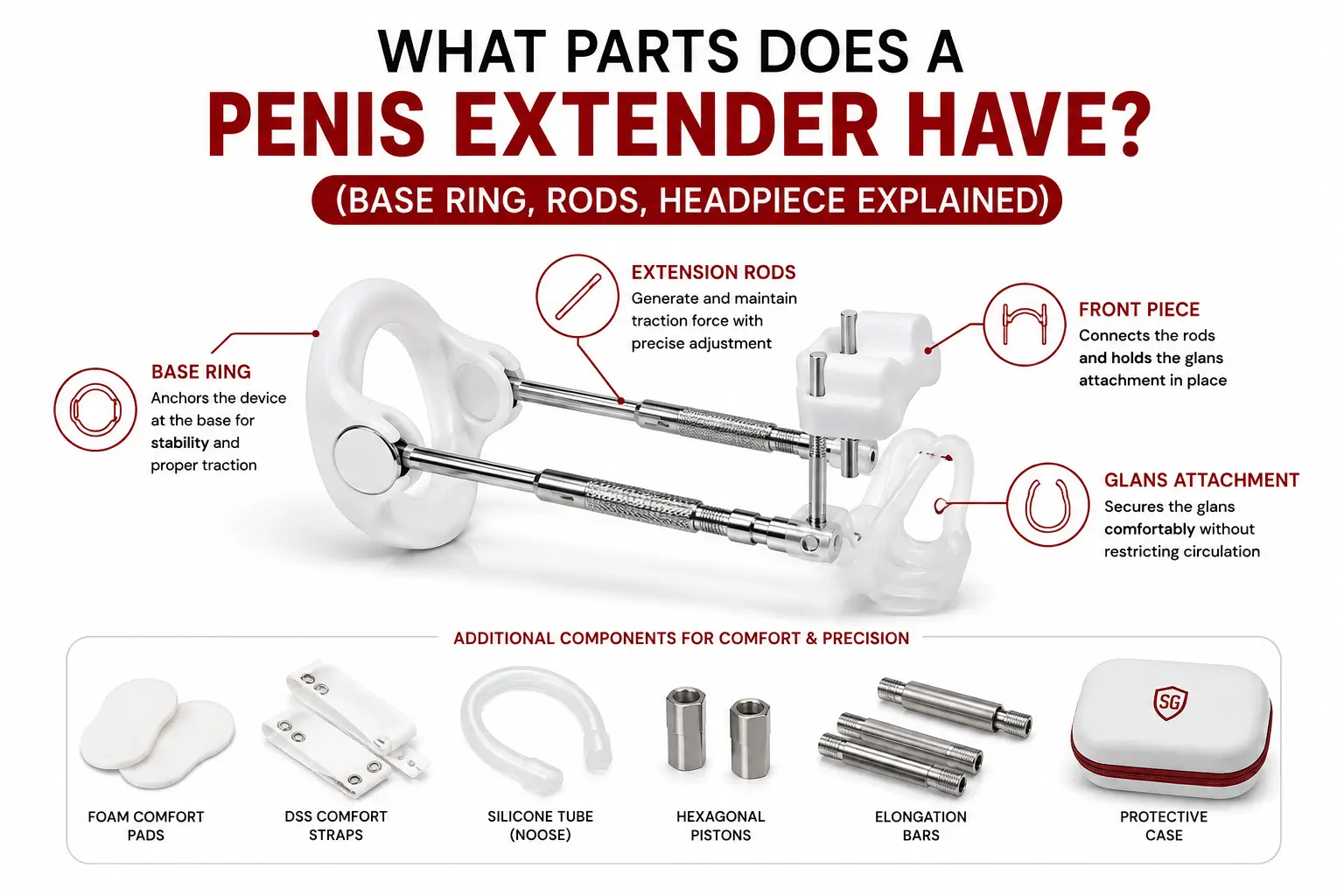
Each major component solves one of these three problems. The base ring is the anchor. The extension rods are the force generator. The headpiece and glans attachment system is the distal grip.
Remove any one component and the mechanical system fails completely. The device either slides off, delivers uncontrolled force, or cannot maintain a consistent therapeutic position.
What Does the Base Ring Do and Why Does Its Size Matter?
The base ring is the mechanical foundation of the entire device. Get it wrong and nothing downstream works correctly.
The base ring — also called the basal unit or cradle ring — sits at the root of the penis at the pubic bone. The extension rods mount to this ring at two fixed points. All traction force transmits forward from this anchor.
For the ring to function correctly, it must make firm contact with the pubic bone, not soft tissue. When the ring anchors against bone, the traction force pulls directly against a stable, non-compressible surface. When the ring sits on adipose tissue, it compresses inward, and the effective traction force reaching the shaft drops. This is why men with significant suprapubic fat must use bone-pressed flaccid length (BPEL) as their rod-length reference — not the skin-surface measurement.
Why ring size matters:
A ring that is too small creates a tourniquet effect at the base of the shaft, restricting venous drainage and causing the glans to become engorged and darkened. A ring that is too large rotates and tilts during movement, generating asymmetric traction across one side of the shaft. The ring must encircle the shaft snugly enough to stay anchored, with enough clearance that a finger slides underneath without cutting off.
Ring materials by tier:
- Medical-grade ABS plastic or rigid polymer: Standard; sufficient rigidity for most users
- Aluminum frame (Jes-Extender): Lighter than steel alternatives; maintains correct position against the pubic bone without adding weight to the overall assembly during extended daily wear
- Stainless steel: Maximum durability and zero flex under load; heavier during multi-hour sessions
How Do the Extension Rods Generate and Maintain Traction Force?
The extension rods generate traction by extending beyond the natural flaccid length of the penis by a small, calibrated amount — placing the tunica albuginea under sustained longitudinal tension. That tension is the mechanical stimulus that drives collagen remodelling and cellular proliferation (cytokinesis) over weeks of consistent use.
How rod adjustment works:
Most quality devices use a screw-thread tensioning mechanism on each rod. Turning each screw clockwise by one half-turn extends that rod by a fixed increment — typically 0.5 cm per half-turn. The precision of this mechanism matters. Coarse adjustment makes it impossible to match individual anatomy or increment tension safely. Screw-thread mechanisms give finer control than notch-and-pin systems, which sacrifice precision for simplicity.
The documented therapeutic tension range across clinical trials runs from approximately 800 to 2,800 grams of force. SizeGenetics delivers up to 2,800 grams at maximum rod extension — sufficient range for the full multi-month progressive protocol that clinical studies used to document 32% flaccid length gains over six months.
Elongation bars (extension inserts):
When gains progress to the point where rods at maximum setting no longer provide meaningful tissue stretch, elongation bars — short additional rod segments that screw into the existing rods — extend the device’s total reach. Jes-Extender sells elongation bars in 1-inch (2.5 cm) increments. A user who starts at 9 cm flaccid and reaches 12 cm over 12 months needs the rods to accommodate 3 cm of additional length throughout that progression. Devices without elongation bar compatibility reach a practical ceiling after modest gains and require full replacement.
Rod materials:
- Steel: Most common; rigid and durable; noticeably heavier against the thigh during 4 to 6-hour daily sessions
- Aluminum (Jes-Extender standard construction): Significantly lighter; maintains structural rigidity needed for consistent tension; users consistently report less thigh intrusion during long sessions
- Titanium (Jes-Extender Titanium edition): Lighter than steel, stronger than aluminium, highly biocompatible for users with metal sensitivities
What Is the Front Piece and What Role Does It Play?
The front piece holds the two extension rods in parallel alignment and provides the mounting platform for the glans attachment. It does not contact the penis directly — its job is purely structural.
The front piece sits just behind the glans and connects the tops of both extension rods at the distal end of the device. The geometry of the front piece determines the angle at which traction applies. A straight front piece delivers straight-axis traction. A front piece with angular adjustment directs the traction vector slightly upward, downward, or laterally — mechanically significant for curvature correction, where force needs to target the plaque specifically rather than just pulling straight ahead.
SizeGenetics uses a dual-function front piece design that allows the headpiece to configure in multiple orientations and combine with different glans attachment systems without replacing the front piece itself. This architecture is what enables the 58-way comfort system to offer multiple attachment configurations from the same structural frame.
What Is the Glans Attachment and Why Is It the Most Critical Component?
The glans attachment is the most technically demanding component because it must accomplish three things simultaneously that conflict with each other.
- Hold the glans securely against a substantial pulling force
- Maintain normal blood circulation through the dorsal vessels and coronal structures
- Stay comfortable against sensitive penile skin for hours at a time
Getting this balance wrong is the most common cause of session-ending problems: numbness, discolouration, pain, and slippage. Different manufacturers have solved this challenge with different mechanical approaches — each with genuine trade-offs.
Silicone noose or tube (Jes-Extender)
A silicone tube or loop threads through the front piece and tightens behind the coronal ridge. The coronal ridge acts as a natural mechanical stop that prevents the attachment from sliding toward the urethral opening.
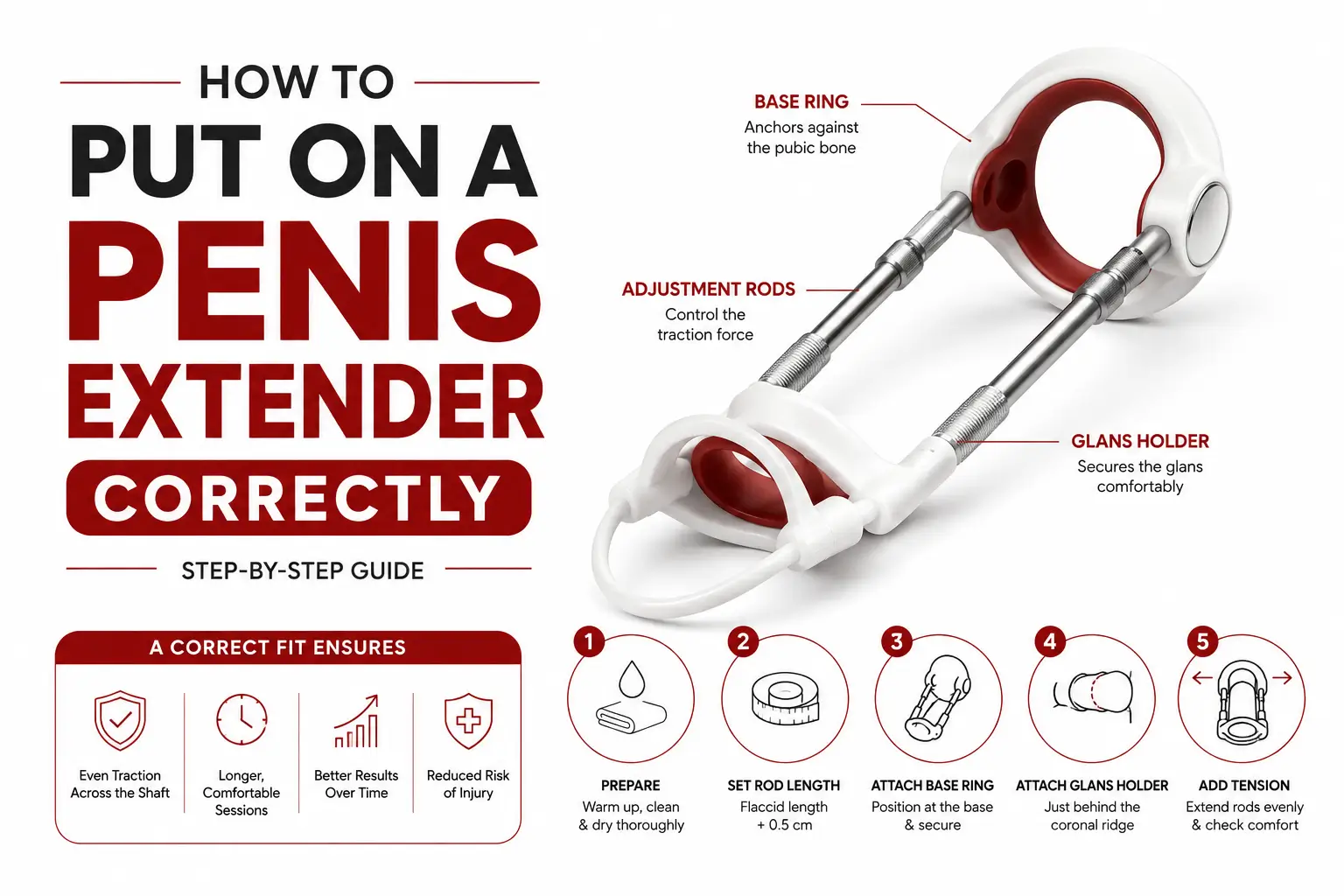
The official Jes-Extender fitting sequence: loosen the tube, slip the device over the penis, push the front piece toward the body until the springs compress, tighten the tube firmly behind the coronal ridge, then release the front piece to let the springs extend and apply initial traction.
The limitation: all contact force concentrates at one point where the tube contacts the underside of the coronal ridge. Over sessions longer than 60 to 90 minutes, this creates hot spots at one specific skin location — the main reason basic noose-only devices are difficult to sustain for the 4 to 6 daily hours clinical protocols require.
Double Strap Support (DSS)
DSS replaces the single noose with two separate silicone or fabric straps that attach at two contact points below the coronal ridge. This doubles the contact surface area and distributes traction force across a wider zone of skin — significantly reducing pressure intensity at any single point. Sessions that cause hot-spot irritation after 45 minutes with a single noose typically extend to 90 minutes or more with DSS before reaching the same irritation threshold.
SizeGenetics includes both noose and DSS configurations, allowing users to rotate between them on alternating sessions so no single contact point accumulates continuous irritation across consecutive days.
Foam and silicone comfort pads
Comfort pads are interface layers placed between the noose or DSS strap and the glans skin. A thin foam pad at the headpiece contact point spreads the strap’s edge pressure over a larger skin area, reducing per-unit-area force at the contact zone. SizeGenetics includes multiple foam pad types and silicone sleeve inserts. The ability to stack a foam pad beneath a DSS strap is one of the configurations that gives the device its extended wearability.
Vacuum cup attachment
Vacuum-based attachment uses gentle suction across the full surface of the glans rather than a strap edge at a single contact zone. A soft silicone cup covers the glans and a small pump creates a partial vacuum, drawing the glans forward and holding it by suction force across the entire glans surface.
Because suction distributes force across the full glans face, vacuum attachment produces the lowest localized pressure per unit area of any attachment system — translating into higher comfort tolerance for extended wear. Two groups benefit most:
- Uncircumcised men, who face foreskin slippage with strap-based attachments
- Men with less pronounced coronal ridges that do not provide a reliable mechanical stop for noose-type attachments
What Are Hexagonal Pistons and Why Do Some Devices Include Them?
Hexagonal pistons give users finer tension control than the base screw mechanism allows — especially useful in the early weeks of a protocol.
These small threaded spacer components fit into the rod adjustment mechanism to provide intermediate tension settings between standard half-turn increments. On devices where a full screw-turn represents a larger tension jump than beginners can comfortably manage, a hexagonal piston allows smaller effective tension increments per half-turn.
SizeGenetics sells hexagonal pistons as replaceable accessories in both right and left versions. For advanced users at high tension settings, they serve a second purpose — maintaining a specific rod length under load without creeping, which can occur in worn screw mechanisms under sustained high tension.
What Do Replacement Parts and Accessories Signal About a Device’s Quality?
Replacement part availability directly signals whether a manufacturer designed the device for long-term therapeutic use or for disposability.
A protocol that produces documented results requires 6 to 12 months of consistent daily use. In that time, silicone tubes degrade from daily friction and body chemistry, foam pads compress and lose cushioning, and elongation bars become necessary as gains progress. A manufacturer that sells replacement components is communicating that the device functions as a long-term tool, not a one-time purchase.
Both SizeGenetics and Jes-Extender maintain full replacement part ecosystems. Replacement elongation bars, silicone tubes, comfort straps, foam pads, and front piece components are available as individual purchases. A broken silicone tube three months into a six-month protocol should cost a few dollars and take a few days to resolve — not force a full device replacement or protocol abandonment.
How Do Material Standards Separate Medical-Grade Devices From Consumer Products?
Medical-grade material standards matter for every component that contacts the skin directly.
For body-contact components — the base ring inner surface, silicone tube or comfort straps, and front piece cradle — three properties determine quality:
- Hypoallergenicity: No allergic response at prolonged daily skin contact
- Chemical stability: No degradation, tackiness, or plasticizer off-gassing under body heat and moisture for 4 to 6 hours per day
- Bacterial resistance: Medical-grade silicone resists biofilm colonization; lower-grade silicone becomes tacky, discolored, and progressively harder to clean after weeks of daily contact
Danamedic ApS, the Danish manufacturer behind both SizeGenetics and Jes-Extender, manufactures to CE medical device certification standards for all body-contact materials. FDA Class II registration for SizeGenetics means materials and safety claims have undergone independent regulatory evaluation — not just manufacturer self-certification.
What Does the Complete Components List of a Clinical-Grade Device Look Like?
A device designed for the protocol that produces results ships with — or makes individually available — this full component set:
| Component | Function | Key quality indicator |
| Base ring (multiple sizes) | Anchors device at pubic bone | Rigid, correctly sized, smooth inner edge |
| Extension rods (pair) | Generates and maintains traction force | Screw-thread precision, consistent spring tension |
| Elongation bars (sets) | Extends rod length as gains progress | Available in increments, sold as replaceable accessories |
| Front piece / distal cradle | Mounts glans attachment, maintains rod geometry | Stable under load, dual-function orientation |
| Silicone tube or noose | Primary glans attachment | Medical-grade silicone, individually replaceable |
| DSS comfort straps | Wider-area glans attachment for longer sessions | Two-point pressure distribution |
| Foam comfort pads | Interface layer reducing contact pressure | Compressible, washable, replaceable |
| Hexagonal pistons | Fine tension increment control | Precision-threaded, material-stable |
| Protective case | Storage between sessions | Prevents component warping and contamination |
A device that ships with only a base ring, rods, and a single noose is designed for the shelf, not for the six months of daily use that the clinical evidence is built around.
Trust me: the component list tells you everything about whether a manufacturer expects you to actually use their device long enough to get results.